Showing posts with label cyber-attack. Show all posts

Thursday, March 31, 2022

Australia PROMISE to retaliate to any cyber attack from Iran! 😲


Australia WILL RETALIATE to any cyber attack from Iran! 

Earlier this week it was reported that defense minister of Australia Peter Dutton stated that any cyber attack that originates from Iranian regime will be responded to by Australia "by an equal measure" 😮

Peter Dutton also says that officials in Australia are monitoring malicious cyber activity on a daily basis. And even though Australia has not been targeted for a month Peter Dutton is concerned that Australia could become collateral damage in a cyber war between other countries. He give example of instances were Microsoft is hacked like they were last week by Lapsus$. Hacks like this also will affect Australian government and innocent Australian people too. He also says that Australia would anticipate hacks from regimes like Iran ahead of time. 


Microsoft was hacked by Lapsus$ last week

Australia works very closely with the United States and the UK and have just opened up a new cyber security center in Australia capital of Canberra to monitor malicious cyber threats. 

Cyber war is changing especially with Russian invasion of Ukraine. And cyber attacks can cause so much damage such as loss of money or business collapse and at the worst injury or loss of life to people.😢

Iran has been publicly named by Australia since 2017 as a country that has launched malicious cyber activities against Australia and Australia will continue to publicly attribute Iran and expose attacks made by them to deter the threat. Iranian regime needs to change its ways!! 😤 

Friday, March 11, 2022

Increase of Iranian cyber attacks on India! Deployment of deadly ransomware in schools!

Local media in India report that cyber attacks from Iran are on the rise. Local media reports indicate that schools and banks as well as government departments such as the police force and defense agencies have been severely targeted. This new wave of cyber attacks has been reported mainly in Kerala and New Delhi as well as in areas such as Bihar and West Bengal.

The Ministry of Home Affairs in India has said that experts are being pressured to accept the requests as a result of the ransomware attack because they are afraid of data being put on  dark web if they do not pay. This type of attack is called Lock and Leak attacks and is very popular with cyber criminals in the Iranian regime.

This follows a public warning that Google issued in 2021 at the CharmingKitten AKA APT35, and I wrote a blog about it here. In that warning, Google said CharmingKitten was using phishing tools to collect data from innocent victims.


Google advisory of CharmingKitten in 2021 

India has always been accustomed to cyber threats from Pakistan and China, but now Iran has to intervene again illegally in another country! When will it stop ??? 😤😤

Wednesday, November 24, 2021

Mahan Air Cyberattack - Exposing dirty secrets of IRGC QF and Further Technical Analysis

Hello friends 🙏 As I promised I continued my research on Mahan Air cyber attack and collected technical analysis for all of you.

It turned out that the hacker group responsible for this cyberattack Hooshyarane Vatan had succeeded in accessing Mahan air systems due to the fact that all sensitive information was not encrypted. It was also revealed that Mahan Airs IT department had actually identified the hackers on the network and had not yet been able to remove them. How bad are the security measures in Mahan Air ???? 😳😳


Hacktivist group responsible for Mahan Air Hack - Hooshyarane Vatan

The first revelation that came out of this cyber attack was evidence that multiple passengers called MR Hamrah Hamrah had boarded flights more than 70000 times on Iranian flights to Syria !! All are booked using the same travel agency called Utab Gasht. Utab Gasht seems to be a legitimate company but it turned out that they regularly transfer funds to a company called Hamrah or Hamrah SYR. Hamrah Company was rarely mentioned by Mahan Air employees, but a number of employees accidently leaked this information and wrote letters to the esteemed CEO of the company Mr. Golparast. Mr. Golparast is an exposed officer of the IRGC and the owner of Qeshm Fars Company which is a front for IRGC!! Mahan air is making dirty deals with IRGC officers !! Incredible! 🤯🤯


Leaked Letter 

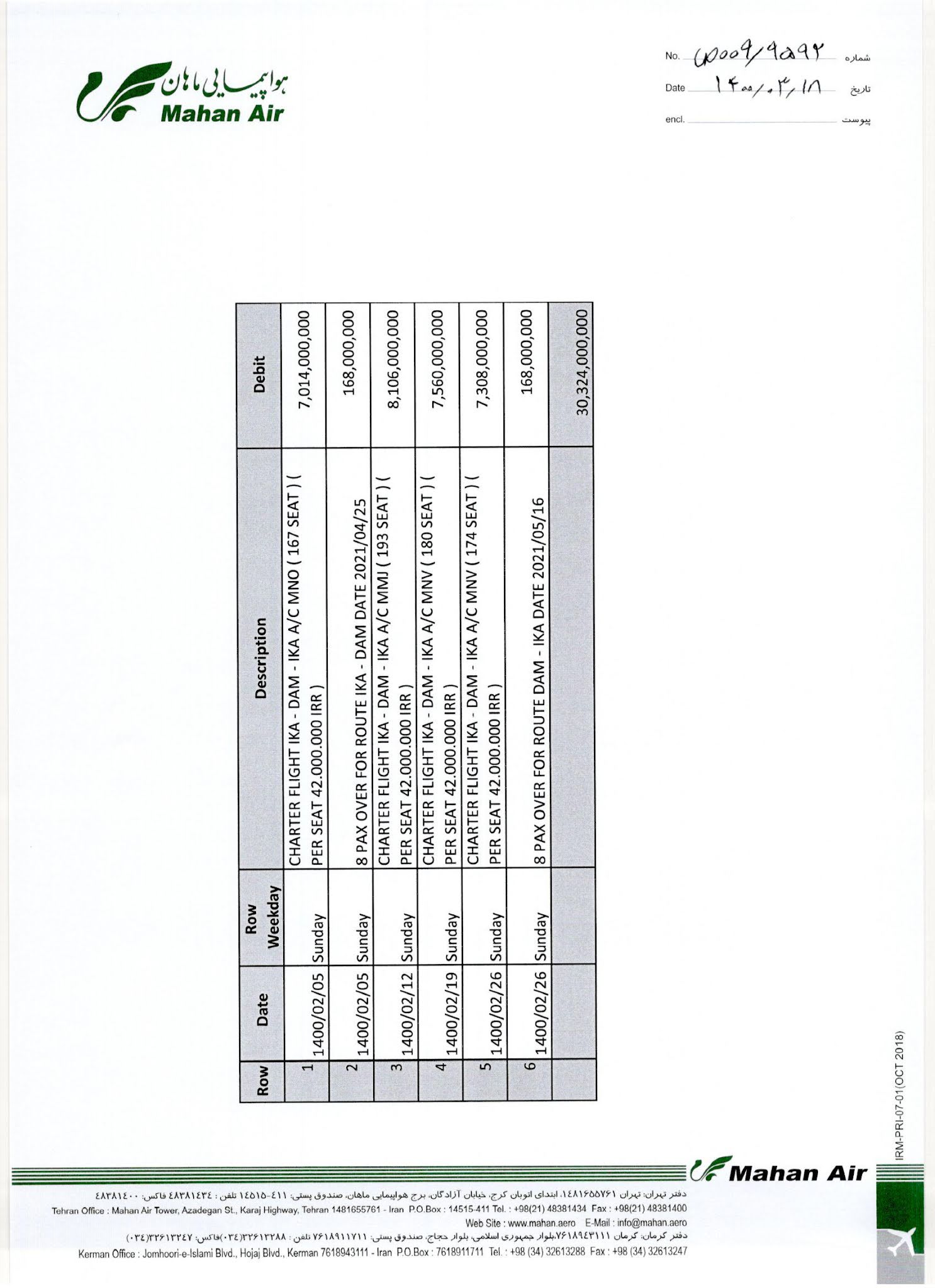
Further analysis of this cyber attack also reveals numerous receipts for charter flights fully booked by the Hamrah company along with hundreds of illegal passengers traveling between Tehran, Damascus and Beruit. This evidence as well as further evidence indicating that passenger load exceeds limits over hundreds of kilograms shows that Mahan Air is actively facilitating the IRGCs QF activities and arms deals in Syria and Hezbollah in Lebanon. There is also a big difference with passengers who board flights and who are registered in the flight system. More than 400 passengers are lost every month under this name. Who knows what other dangerous personnel and cargo the Islamic Revolutionary Guard Corps carries on these flights alongside innocent civilians on flights? Absolutely embarrassing!! 😡


Leaked Invoice for hidden chartered flights 

It was also revealed that all these flights are booked with only 15 phone numbers and also certain people with special privilege are mentioned to board Mahan Air flights. Most likely these are QF IRGC officials. These are listed below:


Phone Numbers and Names used for IRGC QF flight bookings at Mahan Air 


After the technical analysis of this cyber attack it is revealed that Mahan Air has sold its soul to the IRGC and QF. How can Mahan Air do this to the Iranian people? A catastrophe could easily have happened when all these covert and evil deals and trips were completed. The Hamrah company are accompanying Utab Gasht and Qeshm Fars as front companies of the IRGC and its sinister motives and Mahan Air is in bed with them. disgusting! Friends, please do not travel with this airline anymore 🙏🙏

Wednesday, November 17, 2021

Lyceum is back! Targeting ISPs and other strategic targets 😡

Reports this week indicate that the notorious Iranian hacker group Lyceum has returned to chaos and this time mainly attacking Internet service providers and telecom companies in Morocco, Saudi Arabia, Israel and other companies in the wider Middle East including the African Ministry of foreign Affairs

The Lyceum group which was first discovered in 2017 and also known as Hexene has been identified as responsible for a number of cyberattacks in July and October 2021 according to information from Accenture Cyber ​​Threat (ACTI) and Prevailion's Adversarial counterintelligence groups (PACT). The main focus of the Lyceum Group is the implementation of computer network penetration events on a number of strategic target that are appropriate for the Iranian regime. It also now appears that they are expanding their reach to other targets even including places that are friendly to the Iran such as Tunisia.

                        Lyceum: Puppets of Regime!   

The hacker group appears to have stop used its famous Danbot .NET scripts and Powershell scripts to gain unauthorized access to the systems, and is now using a number of new technical techniques to do its evil work. Like the Base64-encoded Powershell scripts and new backdoors written in C++ which are new types of malware called James and Kevin. The group also relies on DNS tunneling which is an intrusion method for using DNS as a secret communication channel which is allowing the group to execute HTTP (S) commands using malicious C2 functionality. More scrutiny of source code also shows that Lyceum is also upgrading its backdoors to stay ahead of defense systems.

Lyceum is evil and guilty perpetrators of Iranian regime and seems to have continue committing ugly acts against other countries in the region regardless of whether they are friends or not. Please friends protect yourself against these types of attacks 🙏 by monitoring DNS traffic and being aware of suspicious domains and report them to threat information platforms.


Will this regime ever stop committing ugly acts in the region?? 😡😡


#cybercrime #cybersecurity #cybercrime #NET #Powershell #cyber #attack #C++ #HTTP #HTTPS #Morocco #SaudiArabia #Tunisa #Israel #Iran #IranianRegime #corrupt #evil   

Thursday, November 11, 2021

Who is DEV-0343??

It has been reported by the Microsoft Intelligence center that malicious password spray attacks which first occurred in July have been attributed to Iranian cybercriminals codenamed DEV-0343, according to the Microsoft Information center.

The term password spray usually refers to a brutal attack in which a cybercriminal uses the same password on multiple accounts, with the goal of locking the account with repeated attempts to gain unauthorized access.

DEV-0343 seeks to target more than 250 Office 365 tenants associated with US, Israeli and EU defense companies, as well as ports and shipping companies in the Persian Gulf. However less than 20 tenants have been successfully hacked.


DEV-0343 

These attacks were simulated by DEV-0343 using an emulated Firefox browser and rotated through IPs hosted on a TOR proxy network. This attempt to remain anonymous did not work, because after analyzing the lifestyle and geographical targeting of known Iranian cybercriminals, it became clear that this was the work of this vicious and intrusive regime. At 7:30 a.m. and 8:30 p.m. Iranian time the group targets hundreds of accounts at a time, praying for just one account for weak cyber security measures.

Friends please protect yourself from this criminal group 🙏. Enable 2FA authentication on all your accounts, block all incoming traffic from anonymous services, and make sure all of your Microsoft Exchange access policies are up to date.

When will this regime stop interfering with the rest of the world while the Iranian people are starving? While Internet blackouts occur regularly? How can the Iranian government continue to claim its lack of money while supporting criminal acts like this? 😡


Follow me on Twitter and Instagram: @_0x7c3

#cybercrime #cybersecurity #cybercrime #DEV0343 #PasswordSpray #cyber #attack #Office365 #Microsoft  

Wednesday, April 4, 2018

A cyber-attack on ideas: Mabna behind latest frightening global phising campaign that targets intellectual property, with allegations of state-sponsorship.

An indictment for nine Iranians was unsealed on March 23 2018. They each stand accused of a variety of crimes relating to cyber-attacks conducted on universities, government agencies, and private organisations around the globe. 31 terabytes of data was stolen - that is a lot of data! The nine suspects are all affiliated with Mabna, the group responsible for the HBO hacking (in which Game of Thrones episodes were leaked), which led to the indictment of Mesri for his involvement in the hacking and attempts to extort US$6 million. It has been revealed that the cyber-assault used customized phishing emails that were sent under the disguise of academics at other institutions. The emails contained links to academic papers that directed the victim to a malicious domain masquerading as a university web page, prompting the victim to give away his log-in details.

Among the victims were government agencies and private companies, but the primary target was universities, with around 8000 professors falling victims. So, unlike the targets identified in previous indictments, we now appear to be seeing a diversification of the type and location of the target. Furthermore, the attack was indiscriminate with regards to academic discipline. Whilst the economic value of the data should not be given disregarded (the indictment makes the cost of the stolen research to USE institutions as US$3.4 billion), the financial loss is only one implication. The concept of targeting innovation, ideas and information, acquired through years of research effort, is new and frightening. The attacks demonstrate the need for academic institutions, to improve their cyber-security, both in terms of the awareness and implementation. It is worrying that the attacks reached beyond the usual suspects of the US and Israel; universities in 22 different counties, including many in Europe, and also China, were victims. Among the non-academic targets was the Unite Nations Children's Fund, demonstrating the callous and indiscriminate way in which the Iranian cyber machine selects victims.

Whilst considered innocent until proven guilty in a court of law, presumably investigators must be pretty convinced of guilt to name these individuals in the indictment. These men will join those previously indicted by the FBI for cyber-criminals, in not being able to leave Iran without fear of arrest. This limitation of freedom will surely deter some of those considering a 'career' in hacking, and slow recruitment to the Iranian cyber-army.

Who is backing Mabna? The indictment reveals that spear-phising email attacks were then conducted on behalf of the Islamic Revolutionary Guard Corps (IRGC) of Iran. But were there other governmental bodies involved? This is a persistent question which resurfaces with each attack. Given their close association, it seems likely that there is some level of co-ordination between the IRGC and other government offices, like those within the Iranian Ministry of Foreign Affairs, when planning the cyber-attacks. Will this public condemnation deter Iran form undertaking further attacks on university, or will the stat simply distance themselves form cyber criminals?

Monday, October 2, 2017

Iranian Hacking Threat to USA if Nuclear Deal Collapses


Since the signing of the nuclear deal between the USA and Iran in 2015 (the Joint Comprehensive Plan of Action (JCPOA)), Iranian cyber attacks against the USA have dropped off. 

The U.S. and six partners began discussions with Iran in 2013 to lift some economic sanctions to limit Iranian nuclear developments, and since then Iranian hackers have largely reduced attacks against the U.S., focusing instead on industrial espionage and hitting rival Middle Eastern countries. However, with the threat by the U.S. President Donald Trump to walk away from the deal, there are fears that Iran will re-start cyber-attacks against the USA.

The cyber-security research company FireEye have produced a report which has identified an Iranian-government group that FireEye have called APT33 (APT means Advanced Persistent Threat, indicating state-involvement). APT33 has previously attacked using spear-phishing techniques to target companies involved in the petrochemical industry and in military and commercial aviation. Could APT33 or similar be ready to attack the U.S. if Trump quits the JCPOA?

A Short History of Iranian Cyber-attacks

  • 2010: It was suspected that the U.S. and Israel attacked Iran with the Stuxnet malware, damaging Iranian nuclear control equipment at the Natanz uranium enrichment plant.
  • 2011/2013: In possible response to Stuxnet, Iran used DDoS (Distributed Denial of Service) Operation Ababil attacks against over 45 major financial institutions. Seven members of the Iranian ITSec Team were subsequently indicted by the FBI for over 176 days of DDoS attacks against the U.S. and also the attack against the Bowman Dam.
  • 2012: APT33 attack the Saudi Aramco oil company using the Shamoon malware, destroying thousands of computers in that company.
  • 2015: After JCPOA, large-scale Iranian attacks against the U.S. dropped off, although this may also have been due to Iran's concerns with Syria and Yemen. Also, APT33 continued espionage attacks against the U.S., South Korea and Saudi. In 2015, many Iranian hacking forums and use of hacker handles disappeared, probably because Iran realized that they were under greater scrutiny. 
  • 2016/2017: APT33 attacked Saudi and U.S. aerospace companies, along with attacks against a South Korean petrochemical company. In May 2017, APT33 attacked a Saudi organization and a South Korean company using malicious spear-phishing emails attempting to target victims with job vacancies for a Saudi petrochemical company.

The FireEye APT33 Report

FireEye state that APT33 used an Iranian developed web-shell developed by the hacker Solevisibile to craft the spear-phishing emails to targets. The webshell (called ALFASHELL, ALFA TEaM Shell v2-Fake Mail), has the default sender email address of solevisible@gmail.com. It is not known if Solevisible is linked with APT33 or not.

APT33 used domain masquerading as the following companies: Boeing, Alsalam Aircraft Company, Northrop Grumman Aviation Arabia, and Vinnell Arabia. APT33 used the domains to target victims with spear-phishing emails.

FireEye identified the hacker xman_1365_x as being the developer of a backdoor used in APT33 malware. It appears that xman_1365_x was also a manager in the Barnamenevis Iranian programming & software engineering forum, and registered accounts in the Iranian Shabgard and Ashiyane forums. The hacker xman_1365_x is also linked with the Nasr Institute, which is similar to Iran’s cyber army and controlled by the Iranian government. The Nasr Institute appears to be linked to the 2011-2013 DDoS attacks on the financial industry (Operation Ababil).

Further indications that Iran is behind APT33

  • A malware dropper (known as StoneDrill) used by APT33 has Farsi language artifacts in it.
  • APT33’s targeting of organizations involved in aerospace and energy is aligned with with nation-state interests (not those of cyber-criminal groups), implying that APT33 is probably government sponsored.
  • Iranian working hours; APT33 worked at the time zone close to 04:30 hours ahead of UTC, which heavily indicates Iran. APT33 largely operated on days that correspond to the Iranian working week (Saturday to Wednesday). Iran is one of few countries that subscribes to a Saturday to Wednesday working week.
  • APT33 used popular Iranian hacker tools and DNS servers used by other suspected Iranian hackers. The publicly available backdoors & tools utilized by APT33 (including NANOCORE, NETWIRE, and ALFA Shell) are available on Iranian hacking websites, associated with Iranian hackers, and used by other suspected Iranian threat groups.

Thursday, May 14, 2015

Iran’s Cyberarmy: Is “Norse Company” as good as they think they are?


A report has been recently issued regarding Iran’s possible plans to carry out cyber attacks in USA. This report is really surprising not only because of the shocking claims but also the identity of the reporters. A Silicon Valley cyber security Company and a Washington think tank which has been one of the strong oppositions of the nuclear deal with Iran had issued this report. The report warns that if US removed the sanctions against Iran, the Iranian government will use the money to strengthen its Cyber warfare program.

However, it is interesting to know that before publication of the report, the Silicon Valley cyber security company has been sharing his information about Iran’s cyber warfare with US intelligence organisations. According to some US government officials, the information provided by the security company received negative reactions from the US officials that were trying to reach nuclear deal with Iran.


Based on this report, which was written by the cyber security company Norse in January of this year, Norse company claimed that it had data on “more than 500,000 attacks on Industrial Control systems over the last 24 months” referring to the computers that help to run electricity generation companies, hydroelectric facilities, and other critical infrastructure in the U.S.

Norse’s claim of half a million “attacks” is a very large number and they haven’t explained or shown any evidence in the document to prove their claim. They have just mentioned that more details are forthcoming in a report that the company will publish “later this year.” The bulletin also claims that Iran is targeting computer systems and Web sites inside the United States.

It seems that Norse company’s conclusions were based on the idea that Iran was behind malicious cyber activity just because the traffic was emanating from particular Internet protocol addresses located in Iran. But hackers routinely use IP addresses outside their own country to hide their true location.
Iranian cyber attacks against U.S. are not new: the cyber attack on the Sands casino company destroyed some of the company’s information assets and Iran was behind an attack on U.S. bank websites in 2012. However, the Norse document was making some of the most possible serious claims in cyber security accusing Iran as a country hostile to the U.S. targeting industrial control systems. 


Later, Norse appeared to remove its findings when its joint report was published in April and the claim of 500,000 attacks is nowhere to be found in that document. The findings also says that Iran specifically targeted Industrial Control Systems (ICS) in the United States 47 times during 2014. Yet again, the final report also doesn’t include that statement.
This report was intended to present a strategic view of Iran’s capabilities in cyberspace—which many U.S. officials have described as growing and dangerous and not to provide evidence for the U.S. to carry out some retaliatory action before any crime has taken place.
Kurt Stammberger, who is a senior deputy managing director at Norse, defended the report by saying that “briefing summaries [such as the bulletin] make theories that sometimes, at the end of the day, aren’t produced by the data”.

Norse’s critics say that it isn’t definitive enough to say that Iran was certainly trying to target industrial control systems. And it could make Iran look like more of a threat than it might actually be.

Even some of Norse’s critics have said that their ability to collect huge amounts of technical data is impressive and important. Although we don’t deny the company’s expertise but they are clearly not an expert on Iran.

Tuesday, March 31, 2015

Massive Power Cut Brings Turkey To Stop : Iran Cyber Attack


Turkey is in process of recovering from a major power cut that brought the country almost to a stop. According to some media reports from Turkey almost the entire country was affected by the massive power cut. Officials are considering the possibility that they were hit by a major cyber attack that was directed at its critical infrastructure.
 
The Turkish government is currently presenting the power cut as technical issue but some suspect that a state sponsor could have authorized this massive cyber attack against Ankaras electric grid and other features of its critical infrastructure.

Turkish officials said that the issue stems from technical problem with the computer system of the Turkish Electricity Conduction Company which is responsible for controlling power lines.

Prime Minister Ahmet Davutoglu stated that every possibility including a terrorist attack is being investigated.

Turkish Energy Minister Taner Yildiz added that officials were investigating whether the power outage was result of a cyber attack. The energy minister said: «I also cannot say whether or not there was a cyber attack. The most important thing for us is to bring the system back to life. This is not something we frequently experience. »

If officials do determine that Turkey was hit by major cyber attack, Iran will likely be seen as primary suspect.


The power cut happened as tensions increasingly rise between Iran and Turkey over past few weeks. Although it takes time to determine attribution from a cyber attack some news outlets report that authorities are highly suspicious that Iran has supported the attack.

Turkish President Recep Tayyip Erdogan recently said condemning the Shiite regime: «Iran is trying to chase [the Islamic State] from the region only to take its place». Turkish president also condemned Iran for aiding «terrorist groups» in taking over Yemen. The remarks that reportedly angered Iranian government officials who demanded an apology from Turkey. 

The two countries have also had major falling out in diplomatic relations due to the Syrian civil war. While Iran is strong supporter of the Assad regime Turkey fiercely opposes Assads grip on Syria. The countries also find themselves on opposite sides about the current conflict in Yemen.

Iran dedicated major resources towards expanding its cyber warfare capabilities over past few years.

Some speculated that Iran became one of the number one cyber threats such as China and Russia. Iran was once considered a D-grade cyber threat. Now its almost on the same level as Russia or China.

Iran also showed that it has the ability to breach the United States critical infrastructure network where Iran infiltrated U.S. water, gas, and transit systems while also successfully breaching airport security networks.
In February Irans Ayatollah Khamenei said in an address to his military cyber units: «You are the cyber war agents… get yourselves ready for such war wholeheartedly. »

Sunday, November 23, 2014

Iran Cyber Attack Feared Soon


Fears are growing that Iran will release cyber warfare on US companies if negotiators fail to reach a nuclear deal by Monday that would require Iran limits its nuclear program.
Cyber-attacks from Tehran dropped after the US, Iran and other countries agreed an interim nuclear deal in 2013, but if discussions in Vienna failed before a November. 24 deadline, observers expect a new series of attacks.

American financial companies, oil and gas companies and water filtration systems could be among the targeted companies. 
 
The US has not yet faced the full force of Iran’s rapidly developing cyber capabilities. Iran initially increased its cyber efforts in 2010 and launched a barrage of simplistic attacks on the US financial sector in 2012. Detecting such relatively harmless attacks was easy.  

Over the last two years, Iran has formed a Supreme Council of Cyberspace that meets once a month and includes President Hassan Rouhani.

Iranian officials also strengthened cybersecurity research partnerships with Russia and Iran has gone from a nascent to a burgeoning cyber power.

Security company FireEye described that one popular Iranian hacking group went from website defacements in 2010 to “malware-based espionage” in just four years.

It is reported that Iranian hackers attacked oil giant Saudi Aramco, the world’s most valuable company, and deleted the contents of 30,000 computers. The same virus also hit Qatar-based liquid petroleum gas firm RasGas.

While the US is bombarded with cyber attacks, it has never been the subject of a large-scale destructive attack. So far Tehran’s hackers are mostly suspected of probing around US infrastructure networks to understand their designs.

But if the nuclear talks fell apart that could change. And this time an Iranian attack could be more advanced.

Wednesday, September 3, 2014

Iran Faces 8 Million Cyber Attacks Per Day


Mahdi Karimi, the deputy-director of Ertebatat Zirsakht Communications Company stated in the company's inauguration speech, that “about 7 to 8 million cyber attacks target Iran’s communication infrastructure daily, which are mostly anonymous, and target the financial and industry sectors as well as more sensitive networks.” Karimi added: “The data network security operations center uses its security capabilities to detect and neutralize threats be they from home or abroad.”

Karimi also noted that the center will collect information on security threats, save data, analyze and respond to cyber attacks as part of its function.

Friday, August 8, 2014

Operation Protective Edge: The Iranian Cyber Botnet Offensive


Cyber-attacks against Israel have increased 500% in the last month and in a new report it is written that a powerful botnet is controlled by a pro-Islamic Iranian group of hackers and was used as part of a cyber-campaign with the support of Anonymous. 
 
The increase in attacks coincided with the launch of Israel's Operation Protective Edge offensive against Gaza.

Following three weeks of intensive attacks on the ground and in cyberspace, the volume of DDoS attacks decreased on 27 July, this coincided with a temporary ceasefire in fighting between Israel and Gaza.

The attack method (which uses things such as "malformed DNS queries", "layer-7 HTTP and HTTP/S attacks", and "repeated page downloads and GETs/POSTs against non-existent URIs") has a "striking resemblance to the Brobot-based attacks" which have been first seen in 2012, but which have been silent for almost a year.

Brobot is a powerful botnet (network of zombie computers) which was first used in 2012 as part of Operation Ababil, which was a series of cyber-attacks carried out by the Qassam Cyber Fighters (also known as the Cyber fighters of Izz Ad-Din Al Qassam) against US financial institutions and continued until July 2013.

Brobot is being used to attack Israeli civilian governmental agencies, military agencies, financial services and Israeli cc TLD DNS infrastructure, and as the Israeli-Gaza conflict continues to evolve, it is likely that we will see the cyber-conflict also evolve alongside it.

Friday, May 23, 2014

eBay Hacked: Change Your Passwords! NOW!


Online marketplace eBay is forcing users to change their passwords after a cyber-attack compromised its systems.

The US firm said a database was hacked between late February and early March and had contained encrypted passwords and other non-financial data.

The company added that it has no evidence of unauthorised activity on its members accounts.

However it said that changing the passwords is "best practice and will help enhance security for eBay users".

The California company has 128 million active users and recorded $212bn commerce on its various marketplaces and other services in 2013.

Facebook said it will contact users via email, its website, adverts and social media to alert them of the issue. 
 
Cyber-attackers accessed the information after obtaining "a small number of employee log-in credentials", that allowed them to access its systems, which facebook first became aware of this only two weeks ago.

Facebook said: "The database... included eBay customers' name, encrypted password, email address, physical address, phone number and date of birth.

However, the database did not contain financial information or other confidential personal information.
Extensive forensics subsequently identified the compromised eBay database, resulting in the company's announcement today."

Although the firm also owns the PayPal money transfer service, but it said that the PayPal data is stored separately and encrypted and there is no evidence that it was accessed.